Louse Glück
The poetry of Louise Glück frequently encourages an examination of mythological frameworks as mirrors for human psychology. Recognized as a central figure in American letters, Glück has consistently utilized classical voices to interrogate modern emotional landscapes. A Nobel Laureate and a Pulitzer Prize winner, she taught for many years at Yale University. Born in New York and raised on Long Island, her early immersion in Greek mythology heavily informs the psychological inquiries present in her verse. Influenced by psychoanalysis and modernists like T.S. Eliot, her work consistently positions natural speech as a fundamental tool for exposing buried truths. As the critic Helen Vendler has observed, Glück’s poems often read like spoken soliloquies, prioritizing a fierce, almost severe clarity. This dialogue with antiquity finds a complex articulation in her poem, “Circe’s Power.”
Circe’s Power By Louise Glück
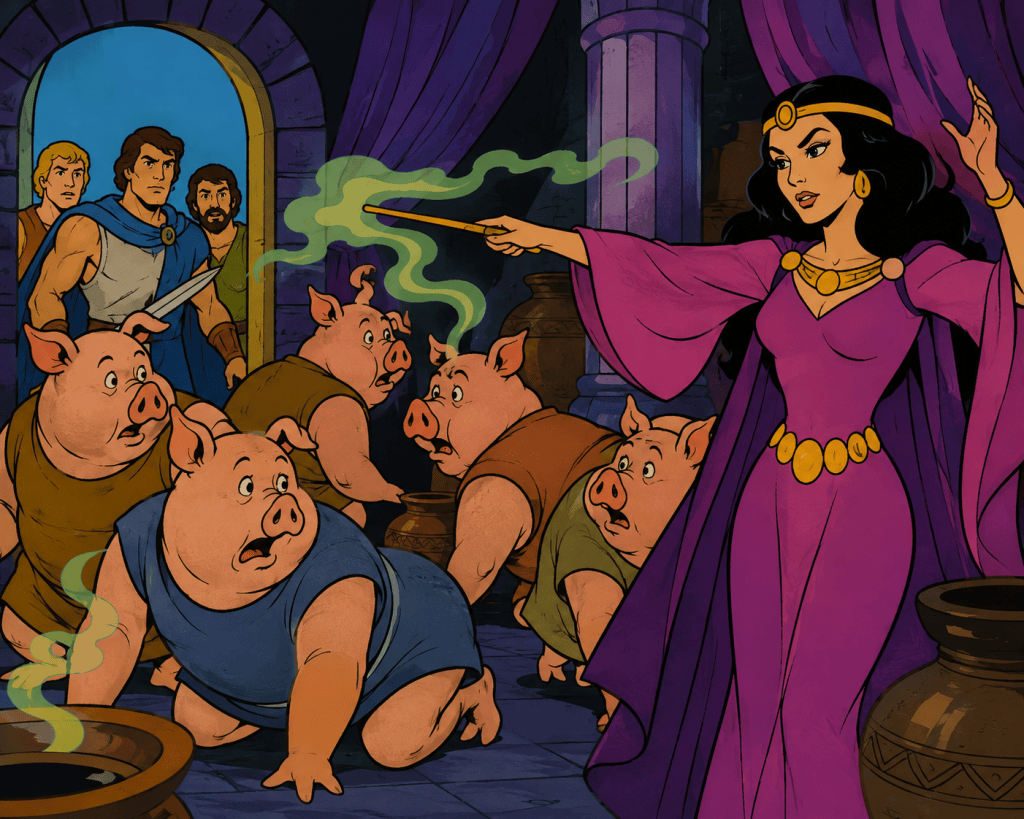
I never turned anyone into a pig.
Some people are pigs; I make them
Look like pigs.
I’m sick of your world
That lets the outside disguise the inside. Your men weren’t bad men;
Undisciplined life
Did that to them. As pigs,
Under the care of
Me and my ladies, they
Sweetened right up.
Then I reversed the spell, showing you my goodness
As well as my power. I saw
We could be happy here,
As men and women are
When their needs are simple. In the same breath,
I foresaw your departure,
Your men with my help braving
The crying and pounding sea. You think
A few tears upset me? My friend,
Every sorceress is
A pragmatist at heart; nobody sees essence who can’t
Face limitation. If I wanted only to hold you
I could hold you prisoner.
The Syntactic Threshold and Narrative Voice
The structural relationship between the speaker and the reader is established immediately through direct address. A dramatic monologue is a poem written in the form of a speech by an individual character to a silent listener, and Glück utilizes it here to allow the sorceress Circe to justify her actions directly to Odysseus. The speaker’s voice consolidates her position when she asserts, “I never turned anyone into a pig.” The tone is unapologetic and shifts the speaker away from the vilified antagonist of Homeric legend toward a highly rational observer of human behavior, suggesting the voice of someone who refuses to accept the hypocrisy of the mortal world, establishing a firm, commanding voice for the poem’s speaker from the outset.
Conceptual Frameworks and the Exposure of Essence
A recurring element of Glück’s poetics involves stripping away romanticized illusions. In this text, she blends mythological narrative with a grounding, almost clinical psychological insight: “Some people are pigs; I make them / Look like pigs.”
Instead of allowing the magic to remain entirely mystical, Glück anchors this transformation as an act of honesty. The speaker claims to be “sick of your world / That lets the outside disguise the inside.” This juxtaposition sustains a tension between the deceptive nature of human society and the terror of Circe’s island. She points out that “Undisciplined life / Did that to them,” blaming their own lack of restraint rather than her witchcraft.
The Pragmatic and Subversive Posture
As the poem traverses the narrative of captivity and release, it adopts a posture that interrogates the dynamic between men and women. The text leans into the mythic by referencing the reversed spell, yet it subverts the expected romantic tragedy with a colloquial, biting humor. Circe notes that as pigs, the men “Sweetened right up.” Brilliant, indeed! Very few poets today can successfully intermingle domestic humor with a serious examination of power dynamics, yet Glück does it without breaking the tension of the poem. Here she draws us more deeply into the psychological reality of the sorceress.
The speaker addresses Odysseus directly when she asks, “You think / A few tears upset me?” This portrays her grief not as a weakness but as a temporary, manageable state. By depicting herself as a pragmatist, the speaker claims an autonomous stance in relation to her own heartbreak.
Mechanics of Perception
The text’s pacing depends upon specific formal techniques. Enjambment is a poetic device in which a sentence or phrase carries over a line break without a major pause or punctuation mark, and Glück uses it repeatedly to pull the reader forward through her logical arguments. When she writes “every sorceress is / A pragmatist at heart,” she utilizes enjambment to stretch the concept of magic into the grounding reality of pragmatism across the blank space of the line ending.
Furthermore, the poem frequently relies on a shifting tone to enact a volta. A volta is a rhetorical shift or dramatic change in thought within a poem, and Glück places one precisely when Circe announces her foresight regarding the departure of Odysseus. The poem transitions from the possibility of simple happiness to the stark reality of separation.
The Final Assertion of Agency
In her essays, Ms. Glück has suggested that the unsaid is often as powerful as the spoken word. The concluding lines of “Circe’s Power” execute a marked shift from the preceding narrative of their shared time toward an intensely localized assertion of dominance.
After the departure of the men and “The crying and pounding sea,” the focus narrows abruptly. The emotional expanse recedes, replaced by the cold reality of the speaker’s capability: “If I wanted only to hold you / I could hold you prisoner.” The poem transitions from the abstract idea of love to the physical threat of captivity. This redirection implies that her choice to let him go is not a failure of her power, but rather a supreme manifestation of it. It is a striking ending that forces us to completely reevaluate the traditional myth, tethering the qualities of magic to the very real boundaries of human choice.


Leave a comment