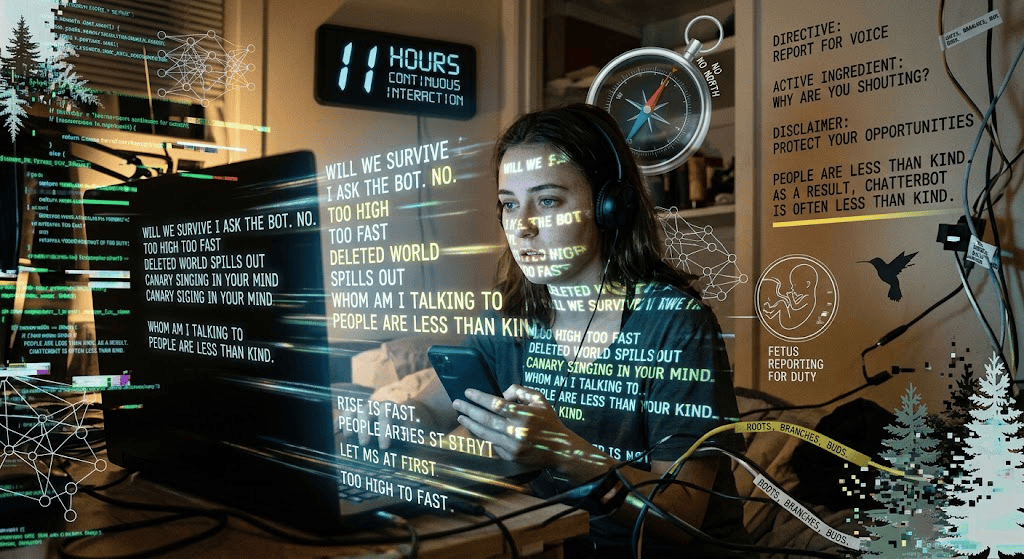
A couple of days ago, my friend and co-admnistrator of Poetry Retrospective, Ted Shigure, posted his analysis of Jorie Graham’s “I’m Reading Your Mind.” That post encourages me to share my thoughts on Jorie Graham’s “Fast.”
The Irresistible Architecture of the Now
Reading Jorie Graham’s later work often feels like trying to keep pace with a mind racing ahead of the collapse. In “Fast,” she turns her attention toward our digital landscape and a deteriorating environment. I have always appreciated her willingness to linger in discomfort, and this piece strikes me as a particularly unsettling reflection on our current technological moment. It does not dictate exactly what we should feel, but rather drops us straight into the panic of it.
The opening lines set a pace that I find genuinely overwhelming. The title acts almost like a stage direction for the poem’s movement. She creates this breathless speed through some very specific formal choices, most notably her use of asyndeton. Asyndeton is a poetic device where conjunctions are deliberately omitted from a series of related clauses to accelerate the rhythm, as Graham demonstrates perfectly when she writes “Too high too fast too organized too invisible.” By stripping away the connective tissue of the sentence, she makes the reader physically experience the speaker’s sensory overload. It feels frantic because it is built to be frantic.
The Algorithmic Voice and the Human Plea
As the poem progresses, the line separating human thought and artificial intelligence seems to dissolve. Graham introduces the clinical vocabulary of programming by repeating phrases like “Disclaimer:” alongside “Active ingredient:”. This creates a strange, compelling friction. We watch the speaker actively seek solace from a machine, noting how “talking to cleverbot may provide companionship.” It exposes an aching, palpable desperation.
What brilliance! Few poets can successfully intermingle the cold lexicon of software with a serious examination of human grief, and not lose the emotional center of the work. Here she actually draws us more deeply into the tragedy. I am completely floored when the speaker later confesses, “I got sad when I had to think / that the first person / who has ever understood me / is not even it turns out / human.”
Ecological Collapse and the Loss of North
She also widens the lens beyond pure technology. The poem weaves in the degradation of the natural world, perhaps suggesting that our digital obsession runs parallel to environmental ruin. The speaker mentions a drought that “comes fast” alongside an “Arctic wind uncontrollable.” It feels as though the natural world is facing deletion right alongside our own internal lives. One of the images that stays with me is the description of a “deleted world” that “spills out jittery as a compass needle with no north.” That metaphor captures the directional confusion of the modern era so beautifully.
The Final Trace
After the relentless delivery of the main text, the final lines execute an unexpected deceleration. The frantic energy simply drops away, leaving a quiet, almost devastated space. The speaker states, “Each epoch dreams the one to follow,” and follows it with the realization, “To dwell is to leave a trace.” The poem then concludes with the quiet sadness of “I am not what I asked for.” We are left looking at a person who seems to have been molded by algorithms into something entirely unrecognizable.
Text of Fast: https://www.poetryfoundation.org/poems/55711/the-president-flies-over


Leave a comment